Cologne, 5th March, 2026
The HClimRep project was presented at the AlgoEarth & CESOC Workshop: Advancing AI Climate Models, held on 4–5 March 2026 at the University of Cologne. The workshop brought together international experts from research institutions, academia, and industry to discuss how artificial intelligence can move beyond short-term weather forecasting toward reliable climate modeling and long-term Earth system understanding. The event focused on key challenges in AI climate science, including limited observational data, complex feedback processes, and the need for new machine-learning architectures capable of representing coupled climate dynamics.
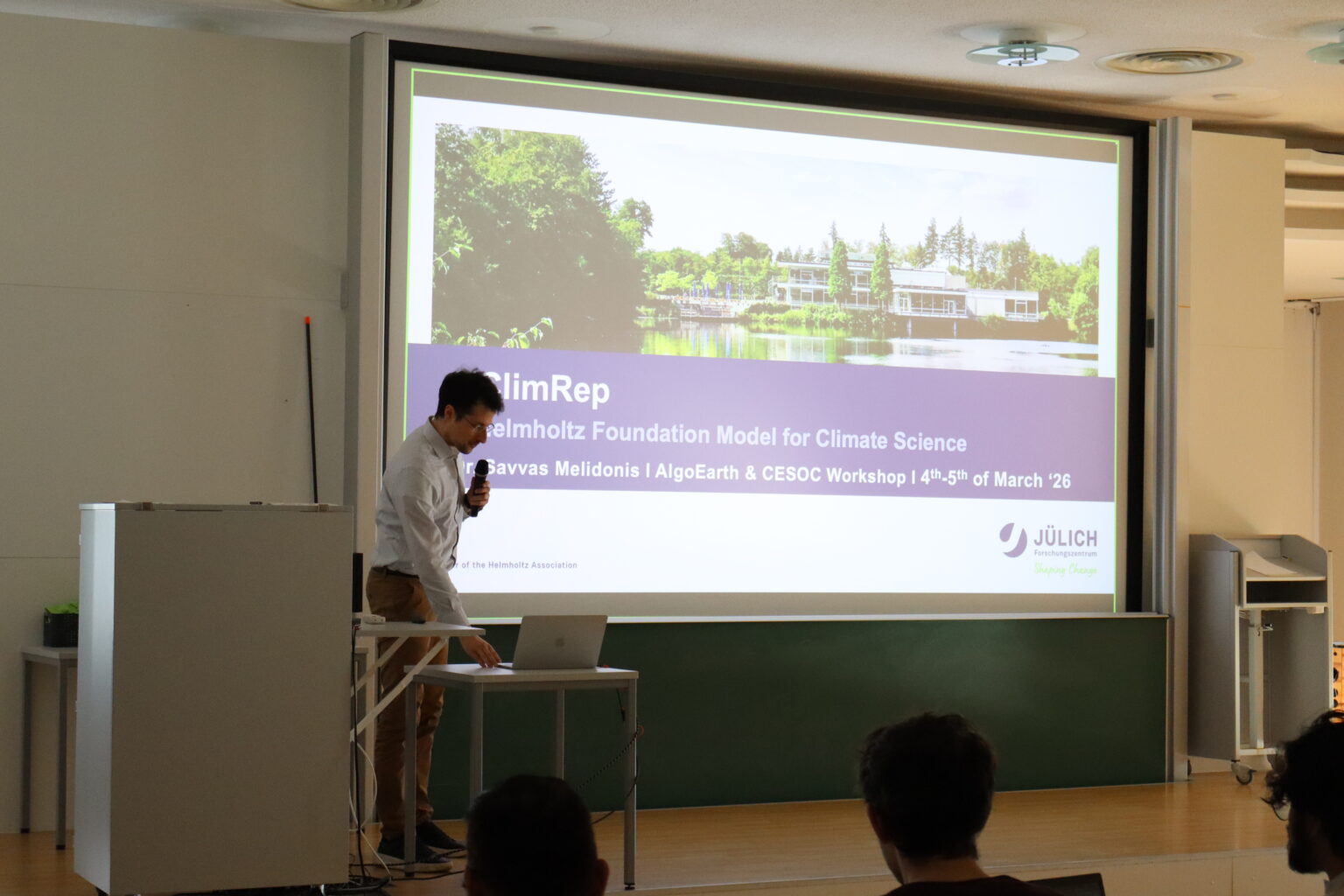
During the workshop, Dr. Savvas Melidonis (Jülich Supercomputing Centre, Forschungszentrum Jülich) presented “HClimRep: A Foundation Model for Capturing the Atmosphere, Ocean, and Sea Ice Interactions.” He explained how the project aims to develop an AI foundation model that learns the long-term interactions between atmosphere, ocean, stratosphere, and sea ice, addressing limitations of conventional physics-based climate models such as computational cost, structural biases, and coarse resolution. Furthermore, he stated that, by combining deep learning with high-performance computing (HPC), HClimRep seeks to bridge the gap between AI-based weather prediction and AI-driven climate projection.
The workshop, organized within the Algorithmic Earth System Science and CESOC frameworks, emphasized interdisciplinary collaboration across machine learning, algorithm design, and Earth system science. HClimRep’s contribution highlighted the growing role of AI foundation models in climate research and their potential to provide new insights into the Earth system while supporting evidence-based climate adaptation and policy decisions.