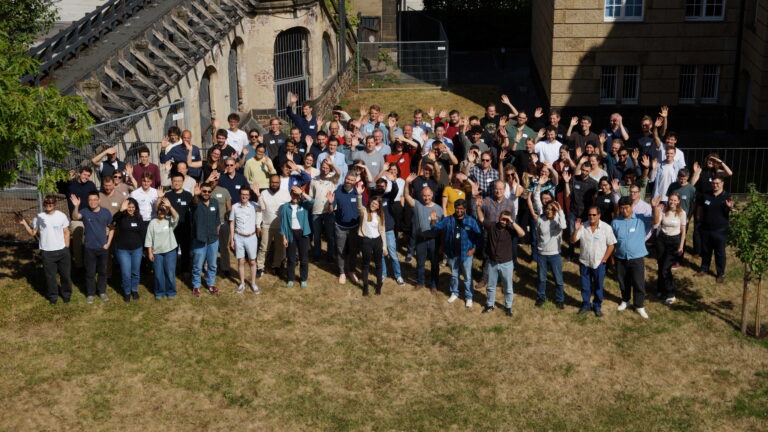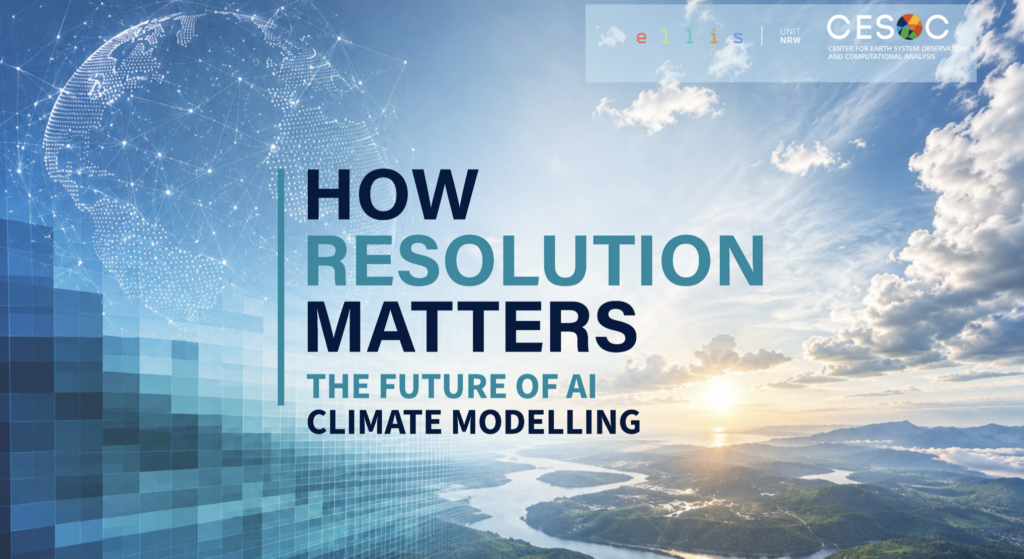
On 6 November 2026, the workshop How Resolution Matters – The Future of AI Climate Modelling brought together experts in atmospheric physics, numerical climate modelling and artificial intelligence at InnoDom Cologne. The workshop was organised by the Center for Earth System Observation and Computational (CESOC) group and supported by the HClimRep project and ELLIS Unit NRW. It addressed a central question for the next generation of AI-based climate models: how much spatial resolution is needed to produce reliable climate predictions?
As AI-based weather and climate models continue to demonstrate promising results at coarser resolutions, an important question is whether computationally expensive high-resolution simulations can be partly replaced by approaches that combine coarse-resolution modelling with AI-based downscaling. Such strategies could substantially reduce computational and energy requirements while retaining important small-scale features. However, representing the interactions between small- and large-scale processes, particularly under changing climate conditions, remains a major scientific challenge.
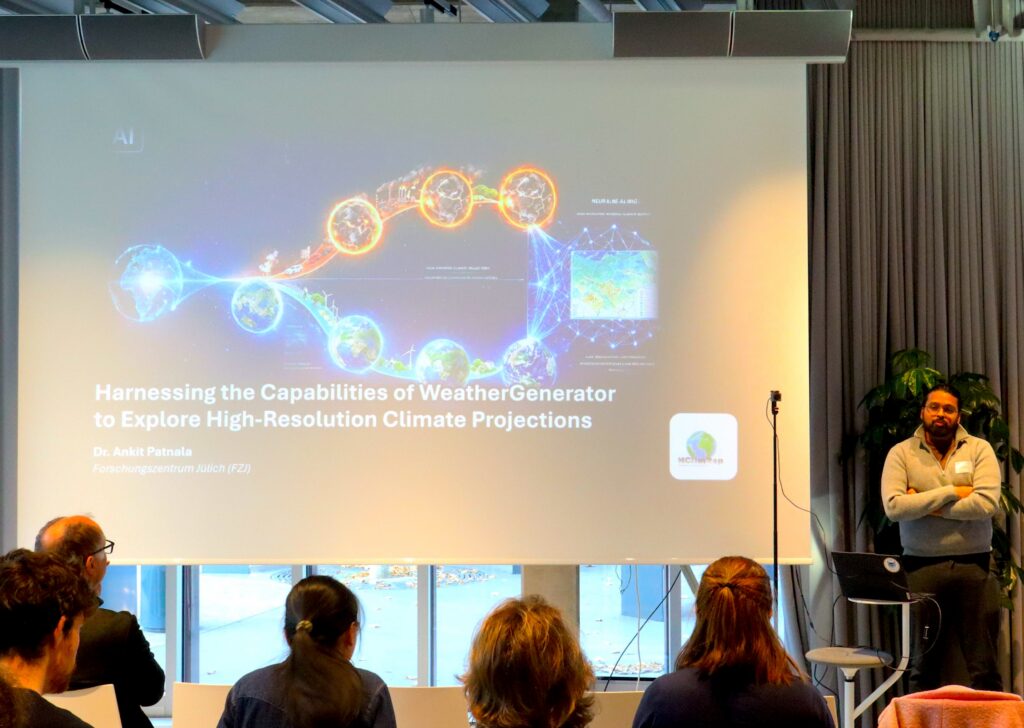
Ankit Patnala, a member of the HClimRep project, contributed to the workshop with his talk, “Harnessing the Capabilities of WeatherGenerator to Explore High-Resolution Climate Projections”. He presented challenges encountered when applying WeatherGenerator to climate modelling and discussed practical strategies developed to address them. His presentation also covered ongoing downscaling activities within the WeatherGenerator project and the issues of generating high-resolution climate projections capable of capturing fine-scale phenomena, including turbulence and mesoscale ocean eddies.
The programme also featured invited Perspective talks by Nikki Vercauteren, Stefan Kollet, Elizabeth Kendon, Greg Hakim and Nils Wedi, addressing resolution challenges from different perspectives, including atmospheric boundary-layer processes, terrestrial systems, high-resolution climate projections and numerical weather prediction. Alongside these invited contributions, short lightning talks gave participants the opportunity to introduce their own research, highlight ongoing work in AI-based climate modelling and share perspectives with the wider community. These contributions fed into breakout sessions and plenary discussions, where participants exchanged ideas, identified open challenges and explored potential strategies for developing future AI climate models that are both physically reliable and computationally efficient.